

Side Balcony
Deck space on a yacht is fixed by the hull. No matter how carefully the general arrangement is planned, the beam defines the boundary — and every owner eventually reaches it. The cockpit feels tight with six guests. The sun loungers crowd the walkways. The aft deck works for boarding but not for entertaining. On vessels under 24 metres, where every square metre of deck competes with propulsion, tankage, and structural requirements, additional outdoor living area is not something the naval architect can simply draw into the hull lines. The space is what it is.
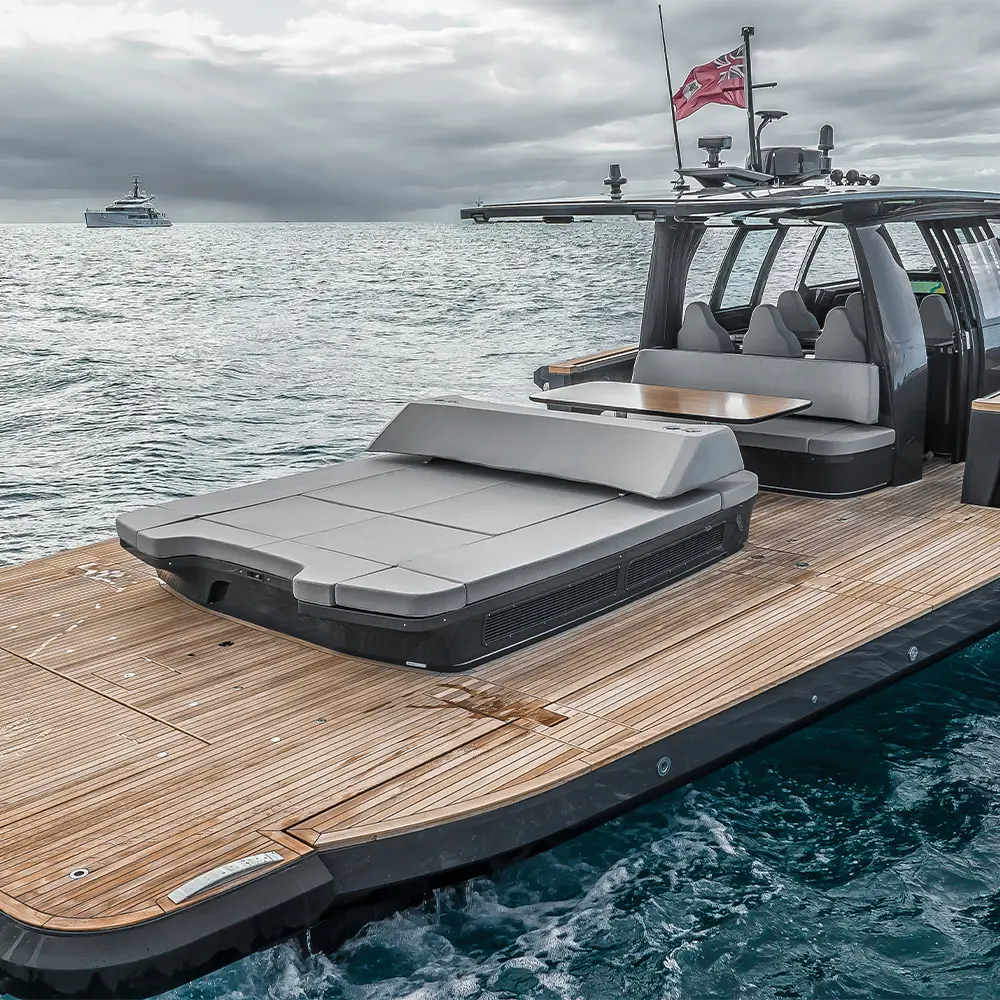
The Side Balcony changes that equation. It is a hydraulic folding bulwark system that opens outward from the hull side, creating additional deck area that extends beyond the vessel’s beam. At the push of a button, a section of the hull wall rotates downward on synchronised hydraulic drives and locks in a horizontal position — forming a stable, railed platform directly above the waterline. The gained area functions as an extended lounge, a sun deck, a waterside bar, or simply as breathing room for guests who would otherwise be confined to the cockpit. When the balcony closes, the panel returns flush into the hull line. No visible hinge points, no protruding hardware, no change to the vessel’s profile. The system is available in two drive configurations — hydraulic rotary drive or hydraulic cylinder drive — depending on the installation geometry and space below deck. Main structural components are manufactured from seawater-resistant stainless steel grades 1.4404 (AISI 316L) and 1.4462 (Duplex), electropolished for long-term corrosion resistance. Each system is delivered complete with hydraulic power unit, synchronised movement control, and all necessary accessories. Every Side Balcony is individually configured to match the specific yacht’s geometry and design language, engineered and assembled at our facility in Münster.
Deck extension at the push of a button — full retraction into the hull line
The Side Balcony operates on a hydraulic drive system that rotates the bulwark panel from its closed, vertical position outward and downward into a horizontal platform. The movement is smooth, controlled, and requires no manual effort — a single button press initiates the full opening sequence. The panel locks in the extended position, creating a stable, load-bearing surface that is flush with the deck level and supported along its entire length.
What makes this system practical rather than merely impressive is the completeness of the retraction. When the balcony closes, the panel does not fold against the hull exterior or sit proud of the surface. It returns to its original position within the hull wall, re-establishing the vessel’s original profile line. From the dock, from a passing vessel, or from a tender approaching the stern, there is no visible indication that the hull contains a fold-out deck extension. This matters on yachts where the design silhouette is part of the vessel’s identity — and it matters commercially on charter yachts where the balcony is a selling feature that should not compromise the vessel’s appearance when closed.
The hydraulic unit delivers synchronised movement with consistent speed across the full opening and closing arc. Integrated safety stops prevent over-rotation in both directions. The system is engineered for continuous marine use and functions reliably in exposed conditions, including sea states where the vessel is rolling at anchor.
Both sides open and close evenly — balanced deck extension port and starboard
On vessels where Side Balconies are installed on both port and starboard, the hydraulic system operates both panels in synchronisation. Both sides open simultaneously, at the same speed, to the same angle. Both sides close simultaneously. This is not a convenience feature — it is a structural requirement. Asymmetric loading from a single open balcony on one side can affect the vessel’s heel, particularly on lighter displacement hulls or when guests move to the open side. Synchronised operation ensures balanced weight distribution and a level deck surface when both balconies are extended.
The synchronisation is managed by the hydraulic power unit, which distributes equal pressure to both drive mechanisms. Each side can also be operated independently when the installation or use case requires it — for example, when the vessel is berthed alongside and only the outboard side is accessible. The control system accommodates both modes: simultaneous operation as default, independent operation selectable via the panel.
For the owner, this means the deck expansion is symmetrical and predictable. For the shipyard, it means one hydraulic unit serves both sides, reducing component count and simplifying the installation compared to two independent systems.
Built from 1.4404 and 1.4462 for permanent saltwater exposure
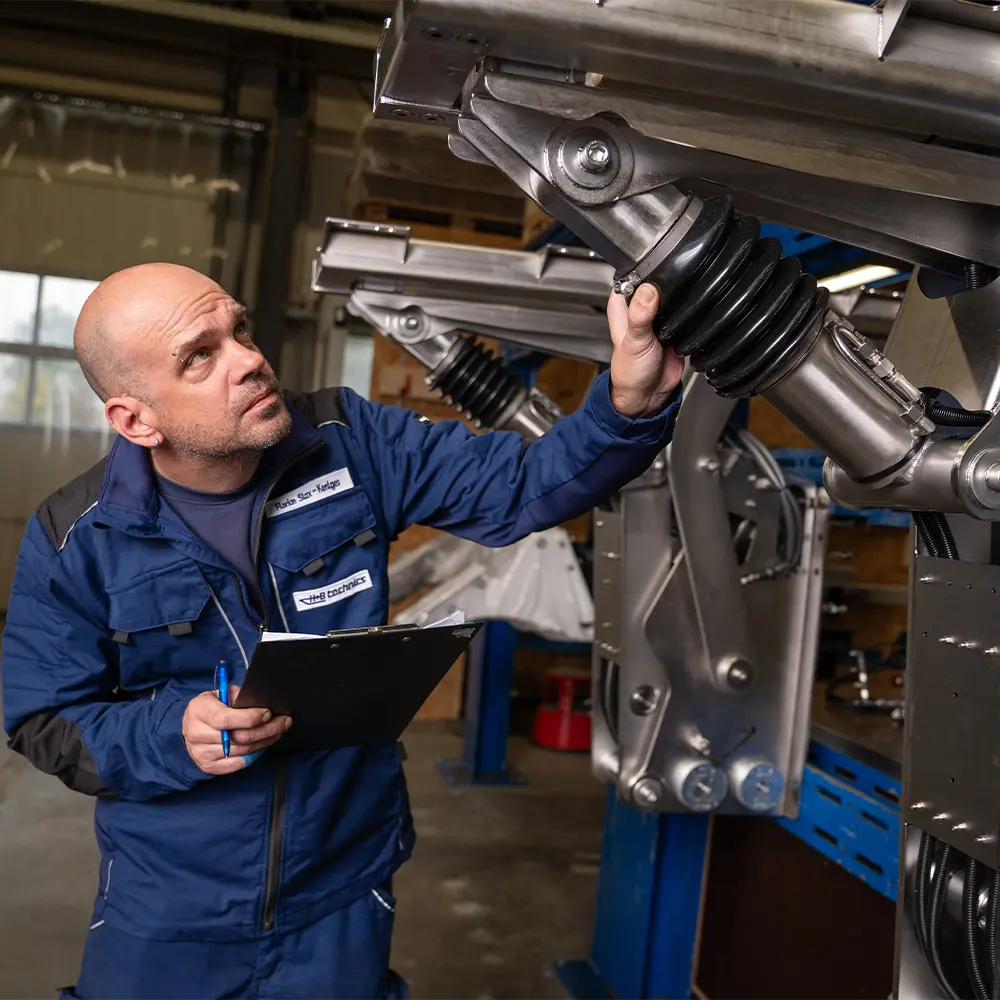
The Side Balcony’s structural components — hinges, support frames, locking mechanisms, and railing posts — are manufactured from stainless steel grades 1.4404 (AISI 316L) and 1.4462 (Duplex). These are not decorative material choices. Grade 1.4404 is the marine industry standard for hardware that remains in permanent contact with saltwater spray and UV exposure. Grade 1.4462 offers roughly twice the yield strength of 316L at comparable corrosion resistance, which allows thinner cross-sections in load-bearing structural elements without sacrificing safety margins.
All stainless steel components are electropolished after fabrication. Electropolishing removes the outermost layer of material, including micro-scale surface imperfections where corrosion typically initiates. The result is a smoother, more chemically homogeneous surface that resists pitting and crevice corrosion significantly better than mechanically polished or passivated surfaces. For a component that spends its entire service life in direct saltwater contact — often in Mediterranean or tropical waters with elevated salinity and water temperature — this surface treatment is not optional. It is what separates a five-year service life from a fifteen-year one.
The railing system is integrated into the balcony structure and designed to meet safety requirements without visual bulk. Railing height, post spacing, and infill material are configured per project to match the yacht’s existing railing design and comply with applicable classification society guidelines where required.
Visual overview
Examine the Side Balcony from every angle — hull integration in closed position, the full opening sequence, and the extended platform with railing detail. Both drive variants — hydraulic rotary drive and cylinder drive — are shown in their respective installation contexts.


Technical Specifications
A hydraulic folding bulwark system that converts hull side panels into stable, railed deck platforms. Opens outward at the push of a button, retracts flush into the hull line when closed.
MATERIAL
Main structural components manufactured from seawater-resistant stainless steel 1.4404 (AISI 316L) and1.4462 (Duplex). All stainless steel parts electropolished for maximum pitting and crevice corrosion resistance. Panel deck surface individually configurable: teak, synthetic teak, composite decking, or custom colour matching.

HYDRAULICS
Hydraulic power unit with synchronised movement control. Two drive variants available: hydraulic rotary drive or hydraulic cylinder drive, selected based on installation geometry and available space. Delivered pre-filled with hydraulic oil, including hoses, fittings, and all necessary accessories.
CONTROL
Push-button operation. Control panel within sight of the balcony. Wireless remotes included as standard. Integrated safety stops prevent over-rotation in both directions.
DELIVERY
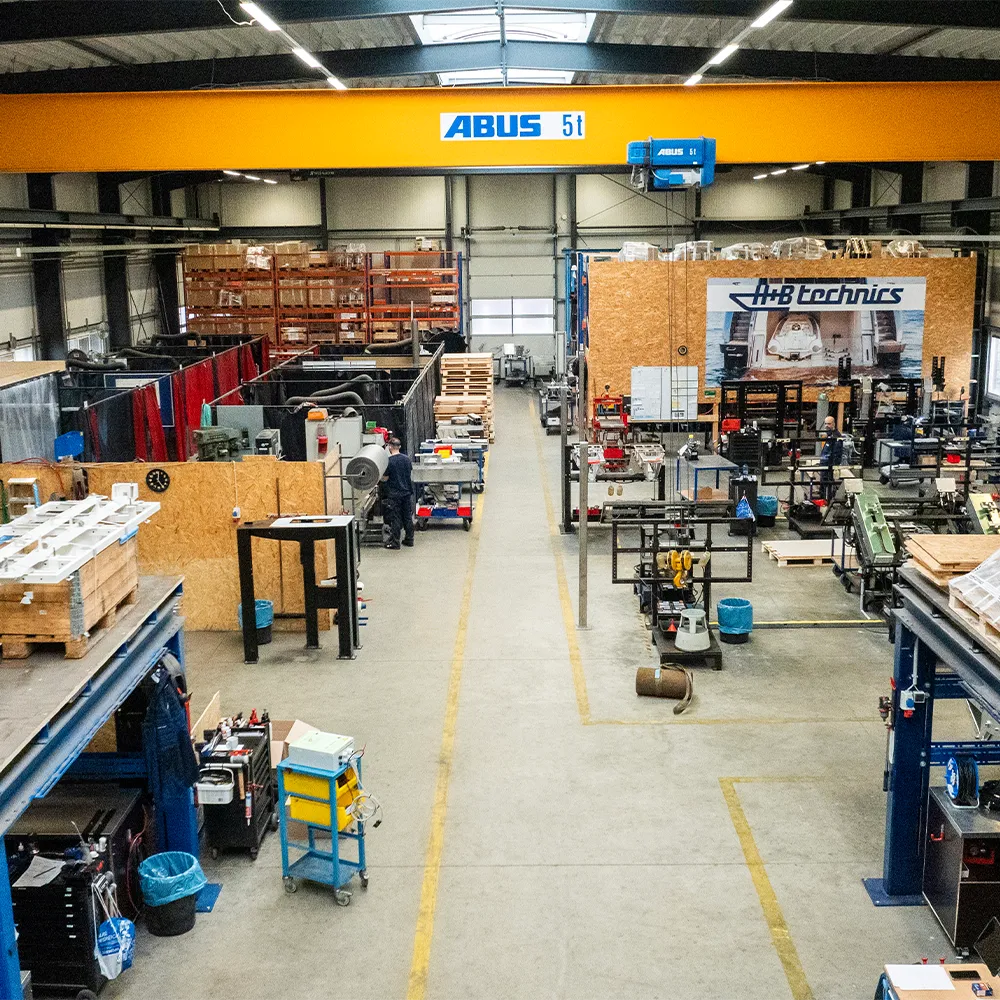
Fully pre-assembled and function-tested at H+B technics, Münster, Germany. Hydraulic unit pre-filled with oil. Ready for direct installation at shipyard or retrofit facility.

"The lifts are not just functional — they match our design and standards. With H+B, it feels more like a team than a supplier relationship."

Frequently asked questions
Answers to the most common questions about the Side Balcony.
The two drive variants serve the same function — opening and closing the balcony panel hydraulically — but differ in their mechanical configuration. The rotary drive uses a compact actuator integrated into the hinge axis, which is ideal where mounting space behind the hull is limited. The cylinder drive uses hydraulic cylinders mounted between the hull structure and the panel, which suits installations with more clearance. The choice depends on the specific vessel’s structural layout and is determined during the engineering phase.
Yes. The system is typically installed as a port and starboard pair, operated by a single hydraulic unit with synchronised movement control. Both sides open and close simultaneously at the same speed. Independent per-side operation is also available via the control panel for situations where only one side needs to be extended — for example, when berthed alongside a dock.
The main structural components are manufactured from stainless steel grades 1.4404 (AISI 316L) and 1.4462 (Duplex), electropolished for maximum corrosion resistance in permanent saltwater exposure. The panel’s deck surface can be finished with teak, synthetic teak, composite decking, or custom colour matching to the yacht’s hull and superstructure.
Yes. The system is suitable for both new builds and retrofits. A structural assessment of the hull geometry is required to determine panel dimensions, hinge positions, and hydraulic routing. This assessment is carried out in collaboration with the owner or shipyard by our engineering team. No hull shape modification is required beyond the panel cutout and structural reinforcement at the mounting points.
The panel returns flush into the hull wall when retracted. There are no protruding hinge points, visible hardware, or gaps that break the hull line. The panel’s exterior surface is finished to match the surrounding hull, making it indistinguishable from the rest of the vessel’s side when closed.
Need more help?
Our team is ready to answer your questions
Customization option
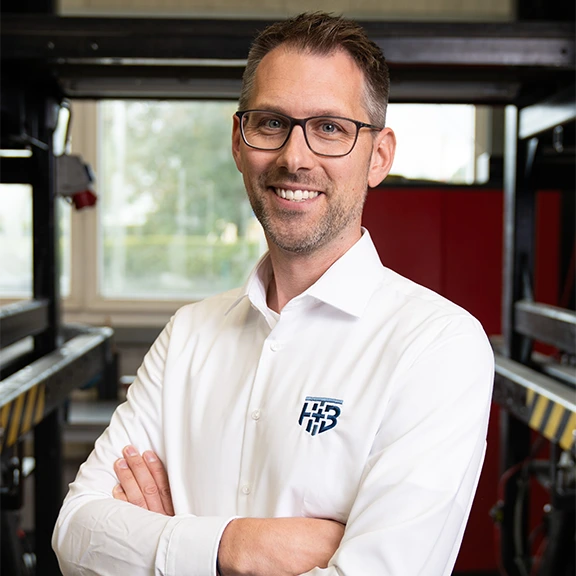
Tailored solutions perfectly suited to your needs. At H+B technics, we not only offer our proven products but also the opportunity to customize them according to your specific requirements. Our experienced team is ready to support you in developing and realizing bespoke products for your yacht or project, always with a strong focus on quality, innovation, and precision.
Whether it’s special dimensions, functions, or an entirely new design, we bring your vision to life. Rely on our expertise and let’s make your ideas a reality together.
Julian Arnsmann
Head of Project & Engineering


Start your project
Tailored solutions perfectly suited to your needs. At H+B technics, we not only offer our proven products but also the opportunity to customize them according to your specific requirements. Our experienced team is ready to support you in developing and realizing bespoke products for your yacht or project, always with a strong focus on quality, innovation, and precision. Whether it’s special dimensions, functions, or an entirely new design, we bring your vision to life. Rely on our expertise and let’s make your ideas a reality together.


