

Telescopic Tender Lift
Launching a tender from a yacht with stern drives, propeller shafts, or exhaust outlets below the transom is a geometry problem. A conventional davit lowers the platform straight down — directly into the path of the hardware underneath. The result is either a collision risk during every launch cycle, or a platform that has to be oversized and mounted further outboard to clear the obstructions, which changes the stern profile and adds structural complexity.
The Telescopic Tender Lift eliminates this constraint. As the hydraulic main cylinder extends, a mechanical lever linkage simultaneously moves the platform carrier downward and away from the hull. The tender clears stern drives, rudder stocks, propeller shafts, and any aft-mounted appendages without contact — in a single continuous motion controlled by one operator. No repositioning, no secondary mechanism, no manual intervention during the stroke.
The system is available across Lift Types 1 through 5, covering safe working loads from 350 kg to 1,200 kg. Types 1–4 use a purely mechanical telescopic linkage; Types 4 (1,000 kg configuration) and 5 offer hydraulic telescopic extension for heavier tenders requiring greater outreach. Every unit is manufactured from electropolished AISI 316L stainless steel at our facility in Münster, delivered fully assembled with hydraulic power unit, hoses, and fittings, and function-tested before shipment.
Combined vertical and horizontal motion from a single cylinder stroke
The core of this system is a lever linkage that converts the linear extension of the hydraulic cylinder into a compound movement: the platform carrier moves downward while simultaneously extending away from the transom. This is not two separate movements sequenced after each other — it is a single, mechanically coupled motion path defined by the geometry of the lever arms and pivot points.
The advantage for the shipyard is straightforward: one hydraulic cylinder drives both the vertical and horizontal components of the stroke. There is no secondary actuator, no separate telescopic rail, and no electronic coordination between two independent axes. Fewer moving parts mean fewer failure points, less hydraulic plumbing, and a more compact installation envelope behind the transom. The linkage geometry is calculated individually for each vessel, taking into account the specific positions of stern drives, exhaust outlets, rudder stocks, and any other appendages that the platform must clear during deployment.
Platform clears drives, shafts, and stern appendages without contact
On a typical stern installation with twin IPS drives or shaft lines, the space between the transom and the propulsion components is narrow. A straight vertical davit stroke would bring the platform directly into this zone. The telescopic linkage avoids this entirely: the outward component of the motion moves the platform past the drives before it reaches their depth, and the platform continues to lower into open water behind the propulsion line.
This is particularly relevant for vessels where the naval architect has positioned stern drives close to centreline for hydrodynamic reasons, or where exhaust risers and trim tabs occupy the area directly below the transom. Rather than designing the platform mounting around these obstacles — which often means wider arm spacing, deeper transom brackets, or an offset installation that compromises symmetry — the telescopic kinematics handle the clearance within the stroke geometry itself. The platform simply goes where it needs to go, collision-free.
Scaled to vessel size, tender weight, and stern geometry
The Telescopic Tender Lift is not a single product — it is a modular system available across five lift types, each engineered for a specific range of vessel sizes, platform dimensions, and tender weights. Lift Type 1 handles 350 kg SWL for compact tenders and jet skis on sport yachts. Types 2 and 4 cover 600–1,000 kg for mid-range RIBs on motor yachts between 15 and 25 metres. Type 5 reaches 1,200 kg SWL for large tenders on vessels above 25 metres.
Types 1 through 4 use the mechanical telescopic linkage. For Type 4 at the 1,000 kg configuration and Type 5, a hydraulic telescopic extension replaces the mechanical linkage, providing greater outreach and smoother motion under heavier loads. The modular architecture means that platform carriers, arm lengths, bracket geometries, and cylinder specifications are all individually configured — not scaled from a single template. Configuration and technical design are carried out in direct collaboration between H+B technics and the shipyard or naval architect.
Visual overview
Examine the telescopic tender lift from every angle — side profile showing the lever linkage, frontal view with twin-arm installation between drives, and 45° perspective of the full deployment sequence.


Technical Specifications
This davit system lifts tenders up to 1,200 kg with hydraulic precision. The mechanical telescopic linkage moves the platform simultaneously downward and away from the hull, clearing stern drives and appendages collision-free.
MATERIAL
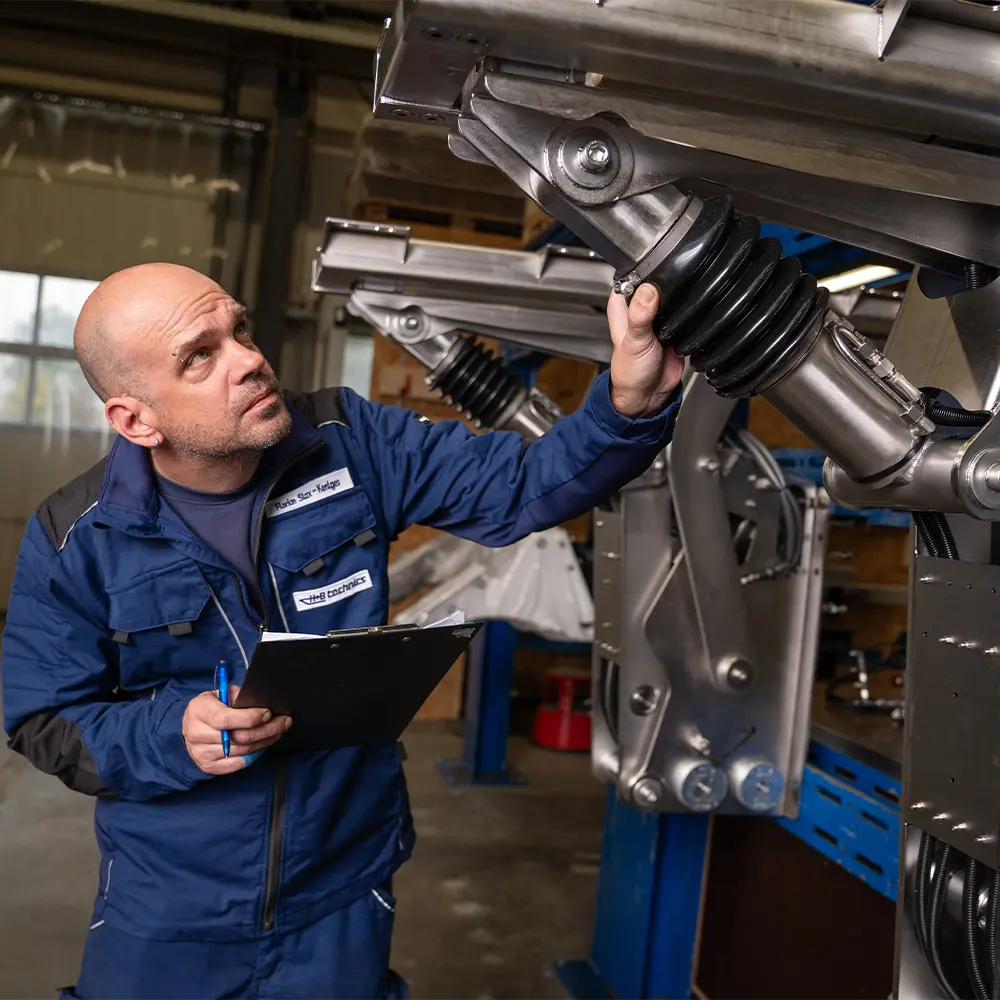
Main structural components manufactured from AISI 316L stainless steel (1.4404), electropolished. Minimum 2% molybdenum content for pitting and crevice corrosion resistance in permanent saltwater environments.

HYDRAULICS
Dedicated hydraulic power unit calibrated for performance, pressure, and volume. Synchronized twin-arm movement via equalizer control block with ±2% tolerance. Optional High Performance block at ±1%. Delivered pre-filled with hydraulic oil, including hoses and fittings.
ANODES
Each system equipped with zinc or aluminium sacrificial anodes. High-quality, code-compliant anodes prevent galvanic corrosion between dissimilar metals in the underwater zone.

PLATFORM CARRIER
Height-adjustable and inclinable to eliminate gaps and height differences between deck surface and platform. Configured to match the specific tender hull profile and deck geometry of the vessel.
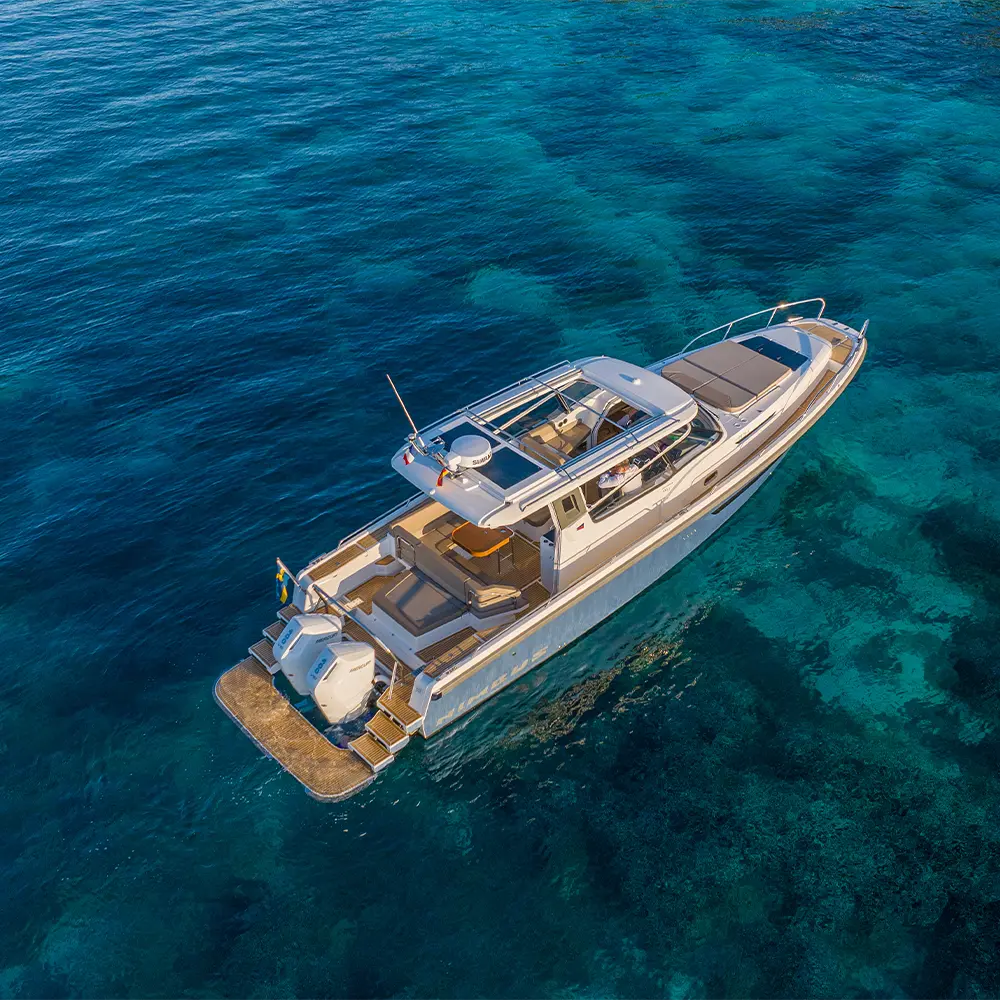

"The lifts are not just functional — they match our design and standards. With H+B, it feels more like a team than a supplier relationship."

Frequently asked questions
Answers to the most common questions about the Telescopic Tender Lift.
A standard davit lowers the platform on a fixed vertical arc. If stern drives, propeller shafts, or exhaust outlets sit below the transom, the platform must be mounted to avoid them — often resulting in wider arm spacing or an offset installation. The telescopic function adds a horizontal motion component: as the cylinder extends, a lever linkage simultaneously moves the platform H+B TECHNICS | Telescopic Tender Lift / Teleskop-Tenderlift | Product Page Content FINAL away from the hull, clearing all stern appendages in a single continuous stroke. No repositioning, no secondary mechanism.
The mechanical version (Lift Types 1–4) uses a passive lever linkage — the outward motion is generated geometrically by the same cylinder that drives the vertical stroke. No additional actuator or hydraulic circuit is required. The hydraulic version (Type 4 at 1,000 kg and Type 5) uses a dedicated cylinder for the horizontal extension, providing greater outreach and more controlled motion under heavy loads. Both versions achieve collision-free deployment; the choice depends on tender weight and required clearance distance.
The standard equalizer control block synchronizes the twin arms within ±2% throughout the full stroke. For wide platforms, heavy tenders, or vessels with pronounced roll, the optional High Performance control block reduces this to ±1%. Both options maintain synchronization under load and during dynamic conditions at sea.
Yes. The system requires structural mounting points on or behind the transom and access for hydraulic lines to the power unit location. Our engineering team assesses retrofit feasibility based on the vessel’s stern drawings or an on-site survey. Because the system ships fully pre- assembled with a pre-filled hydraulic unit, installation time on board is significantly reduced compared to systems that require on-site assembly and commissioning.
Regular inspection of hydraulic hoses, cylinder seals, and pivot bearings during the vessel’s standard service cycle. Check sacrificial anodes annually and replace when depleted. Rinse the mechanism with fresh water after saltwater exposure to prevent salt build-up in the linkage area. The electropolished stainless steel structure requires no re-polishing or protective coating treatment. We recommend a functional test of the safety lock and emergency stop at the start of each season.
Need more help?
Our team is ready to answer your questions
Customization option
Tailored solutions perfectly suited to your needs. At H+B technics, we not only offer our proven products but also the opportunity to customize them according to your specific requirements. Our experienced team is ready to support you in developing and realizing bespoke products for your yacht or project, always with a strong focus on quality, innovation, and precision.
Whether it’s special dimensions, functions, or an entirely new design, we bring your vision to life. Rely on our expertise and let’s make your ideas a reality together.
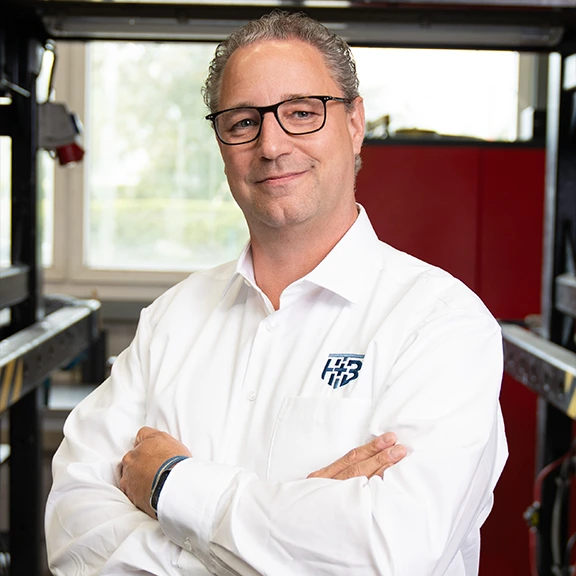
Jan Olfenbüttel
Head of Sales & Marketing


Start your project
Every Telescopic Tender Lift is individually configured for your vessel. Share your GA drawings, stern geometry, and tender specifications, and we support you from the first concept to the finished installation.


