

Linear Lift System
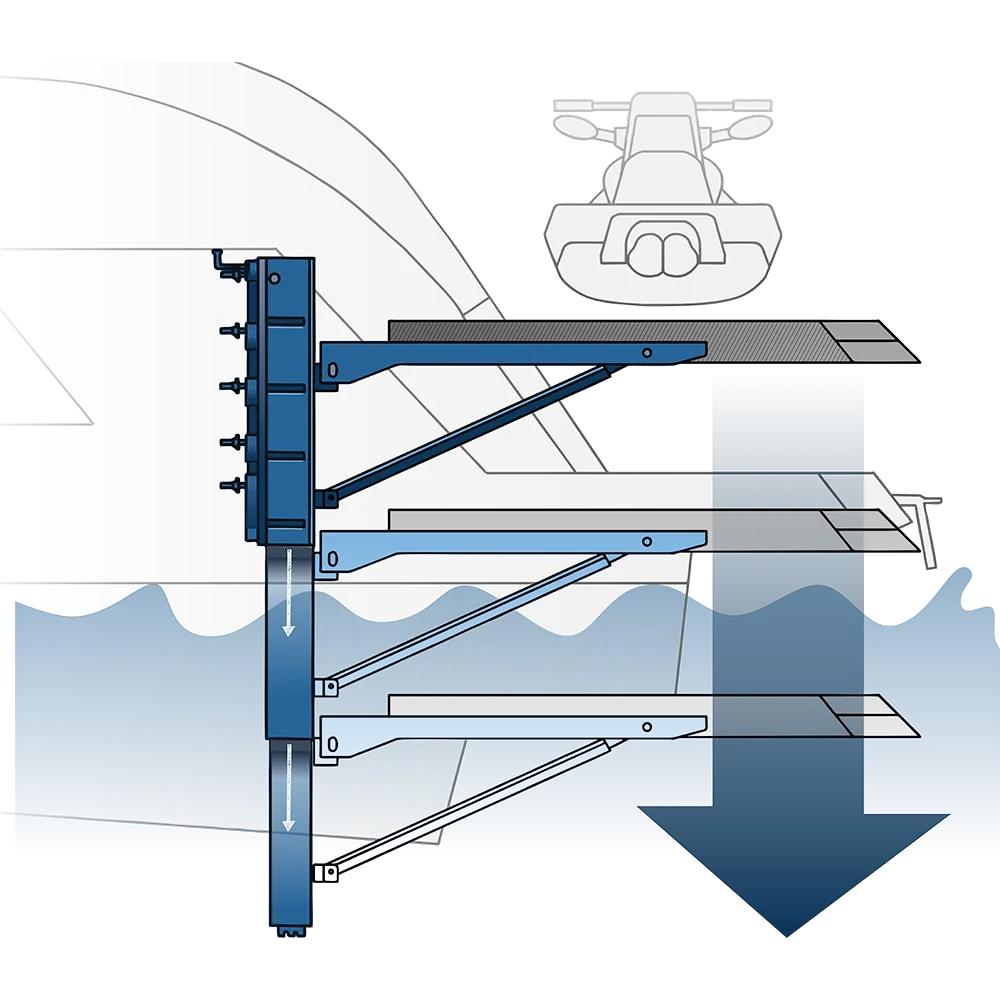
On a catamaran, the stern profile is vertical or near-vertical. There is no curved transom toswing a davit arm around, no hull curvature to guide a rotation arc. A conventional rotation lift system simply does not fit the geometry. What is needed is a straight, vertical stroke — a platform that descends along the transom face on a guided path, lowers the tender to the waterline, and returns the same way.
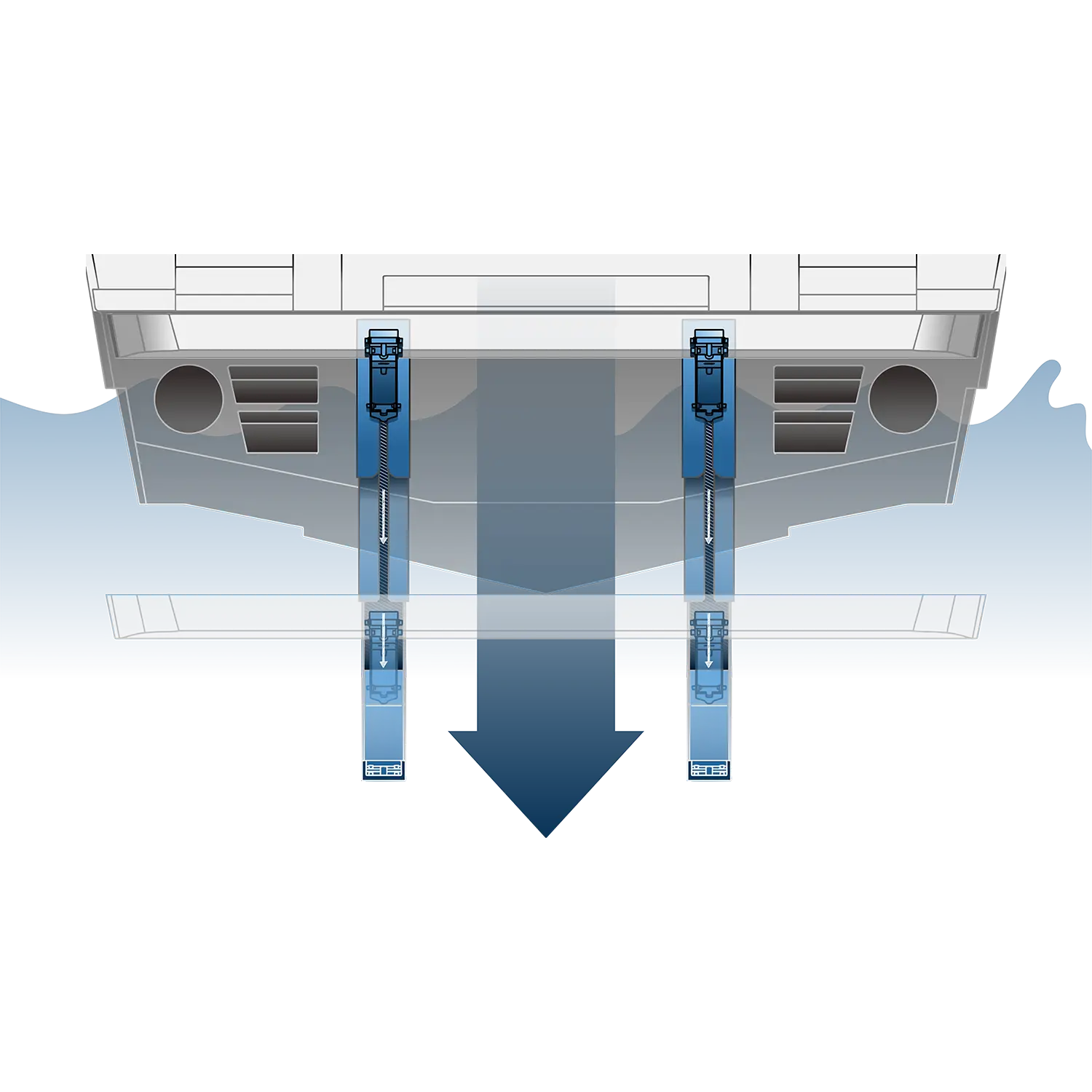
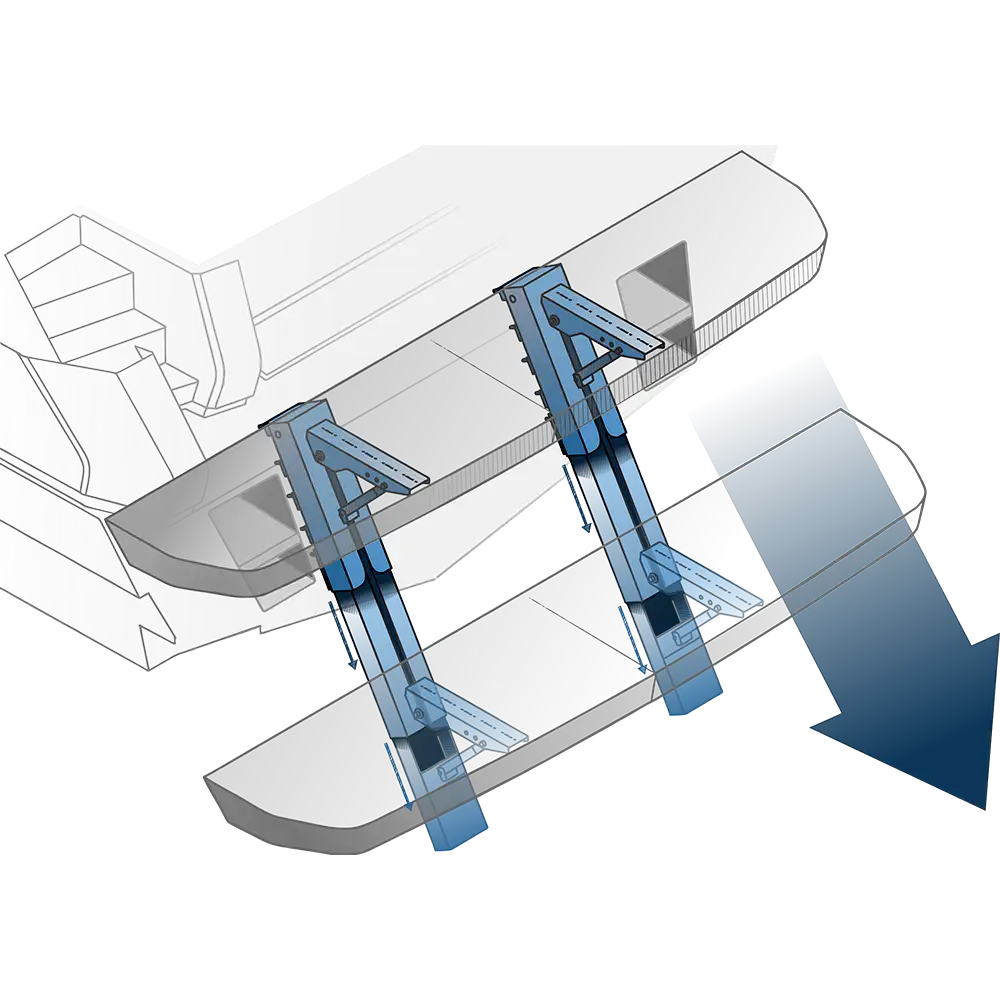
The Linear Lift System does exactly this. Twin hydraulic lift arms travel along vertical guide rails mounted flush to the transom. The platform carrier moves straight down, parallel to the hull, without any lateral swing or rotational arc. This makes it the only lift architecture that works on flat-stern catamarans, centre-cockpit motorboats, and any vessel where the stern geometry demands a linear travel path rather than a pivoting motion.
Five capacity levels cover tenders and jet skis from 500 kg to 1,200 kg SWL. The lift arms and primary structural components are manufactured from AISI 316L stainless steel (1.4404), with high-load variants using Duplex steel 1.4462 for superior yield strength in demanding installations. Each system is delivered fully pre-assembled with hydraulic power unit, wiring harness, control panel, and two wireless remotes — ready for direct installation at the shipyard. Configuration is carried out in close collaboration between our engineering team in Münster and the builder.
Straight-path travel for flat and angled transoms
The defining characteristic of the Linear Lift System is its guide rail: a vertical track mounted directly to the transom, along which the lift arms travel without lateral deflection. The platform descends in a straight line, maintaining a constant distance from the hull surface throughout the full stroke. This eliminates the swing radius that rotation davits require — a radius that, on a flat- stern catamaran, would collide with the hull itself.
The guide rail accommodates transom angles from 0° (fully vertical, typical for sailing catamarans) to 30° (inclined aft, common on power catamarans and some motorboat designs). The mounting hardware is configured for each transom profile individually, ensuring the rail sits flush against the hull surface regardless of angle. Because the travel path is constrained by the rail, the platform position is repeatable within millimetres — every launch and recovery places the tender at exactly the same point, which simplifies crew operations and reduces the risk of hull contact during handling.
Engineered for hull forms that rotation systems cannot serve
Rotation lift systems rely on a pivoting arm that sweeps the platform through an arc. This works well on monohulls with a curved transom, where the arm can rotate outboard and clear the hull. On a catamaran — where the transom between the two hulls is a flat vertical surface and the hulls themselves bracket the platform on both sides — a rotation arc has nowhere to go. The linear system solves this structural limitation by eliminating the arc entirely.
Beyond catamarans, the system serves centre-cockpit motorboats, trawler yachts, and expedition vessels where the stern profile is box-shaped or vertical rather than contoured. On these hull forms, the available space behind the transom is typically narrow: there is little room for swing-out arms or extended lever linkages. The linear guide rail requires minimal depth behind the mounting surface, making it the most space-efficient davit architecture for constrained stern installations. The platform carrier is height-adjustable and inclinable, allowing precise alignment with the deck surface to eliminate gaps and height differences at the boarding edge.
Higher yield strength for demanding load configurations
The standard material for all Linear Lift System components is AISI 316L stainless steel (1.4404), electropolished for corrosion resistance and surface hygiene in permanent saltwater environments. For installations with higher structural demands — heavy tenders, extended stroke lengths, or vessels operating in extreme conditions — the lift arms and critical load- bearing brackets can be specified in Duplex stainless steel 1.4462.
Duplex 1.4462 combines the corrosion resistance of austenitic steel with roughly double the yield strength: approximately 450 MPa compared to 220 MPa for standard 316L. This means structural sections can be designed with less material while carrying the same load, reducing the weight of the lift arms without compromising safety factors. For a catamaran builder counting grams per component to stay within displacement targets, this is a measurable advantage over systems built entirely from standard austenitic grades. The choice between 316L and Duplex is made during the engineering phase based on load calculations and the shipyard’s structural requirements.
Visual overview

Technical Specifications
This davit system lifts tenders up to 1,200 kg along a vertical guide rail. Designed for catamarans and motorboats with straight stern profiles where rotation systems cannot operate.
MATERIAL
Lift arms and primary structural components: AISI 316L stainless steel (1.4404), electropolished. High-load variants available in Duplex stainless steel 1.4462 (approx. 450 MPa yield strength vs. 220 MPa for 316L). Minimum 2% molybdenum content in both alloys for pitting resistance.

HYDRAULICS
Hydraulic power unit calibrated for performance, pressure, and volume. Synchronized arm movement via equalizer control block with ±2% tolerance. Available in 12V or 24V to match
ANODES
Zinc or aluminium/magnesium sacrificial anode package. Code-compliant anodes prevent galvanic corrosion between dissimilar metals in the underwater zone. Anode type selected based on vessel’s cathodic protection system.

DELIVERY
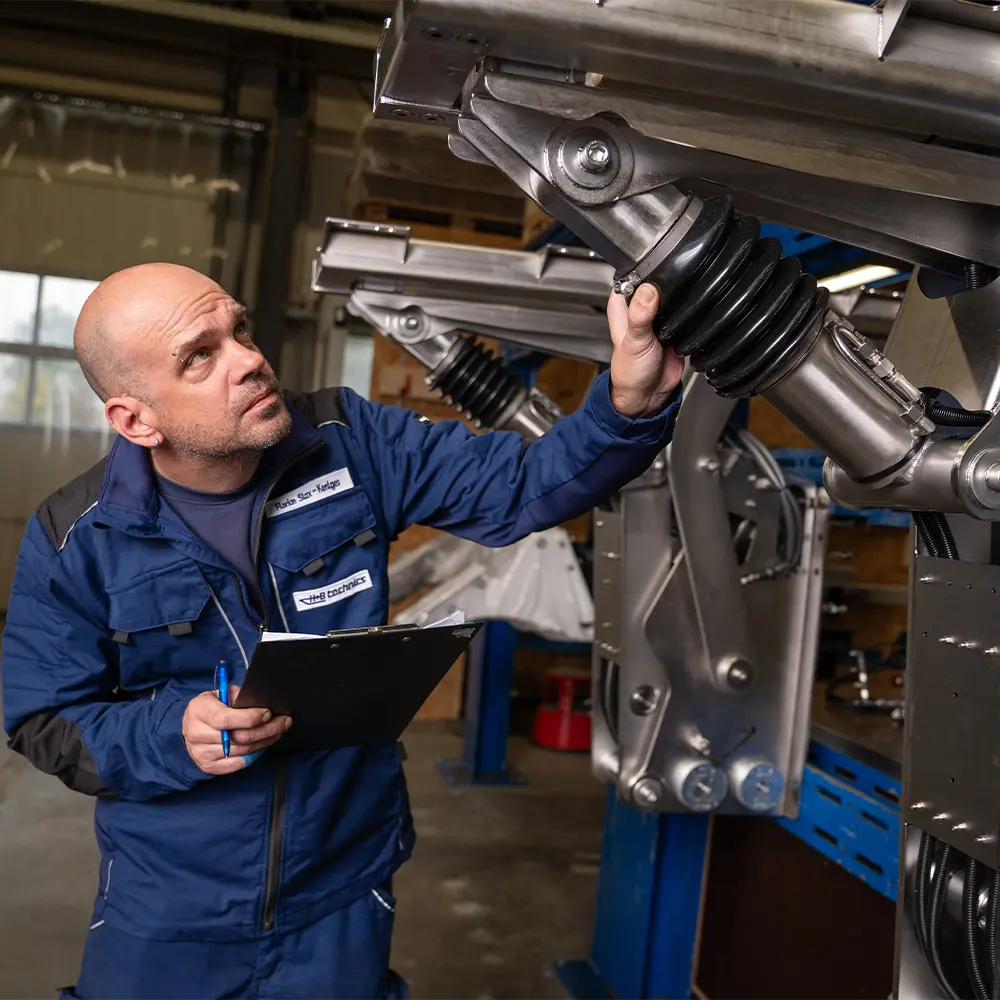
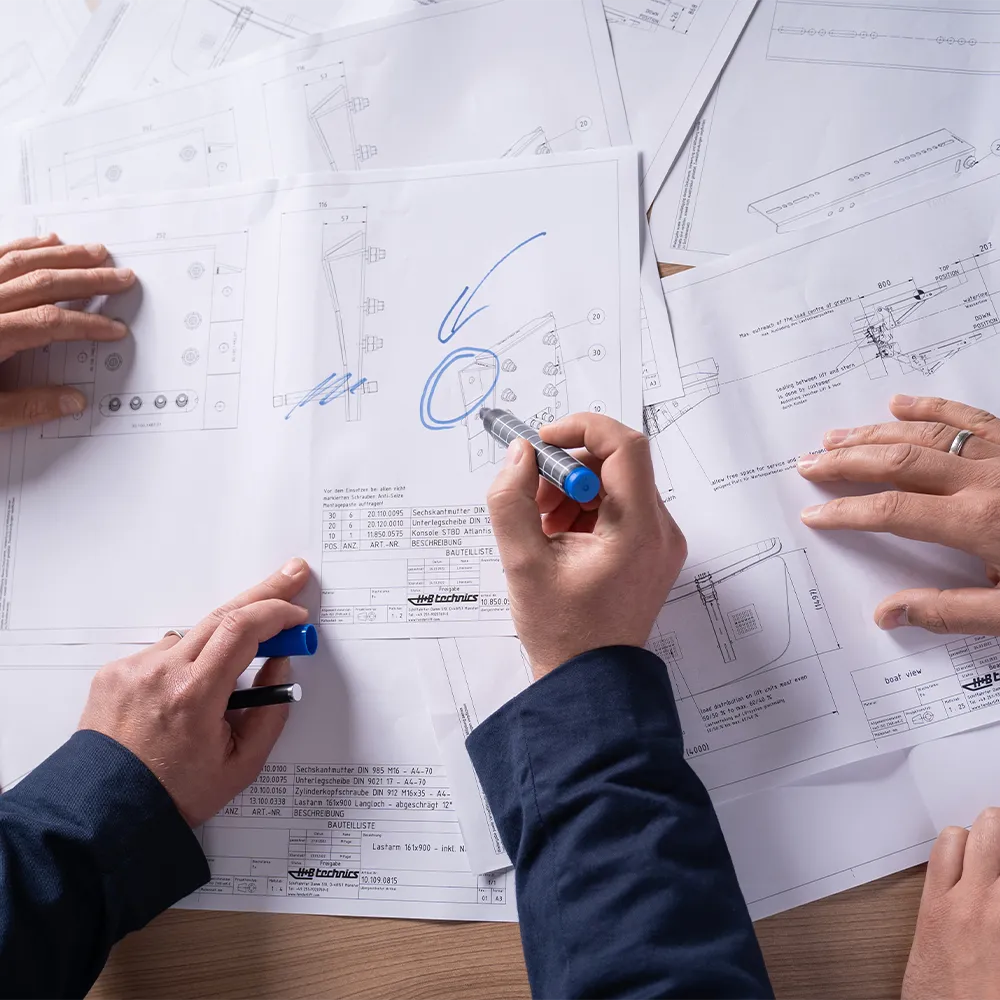
Fully pre-assembled and function-tested at H+B technics, Münster, Germany. Hydraulic unit pre-filled. Wiring harness plug-ready. Detailed installation manual with photographs and technical drawings included.

"The lifts are not just functional — they match our design and standards. With H+B, it feels more like a team than a supplier relationship."

Frequently asked questions
Answers to the most common questions about the Linear Lift System.
A rotation davit pivots the platform through an arc. On a monohull with a curved transom, the platform swings outboard and clears the hull. On a catamaran, the transom between the two hulls is flat and the hulls themselves bracket the space on both sides. A pivot arc would collide with one or both hulls. The Linear Lift System avoids this entirely by moving the platform straight down along a vertical guide rail — no arc, no lateral swing, no hull contact.
Duplex 1.4462 offers roughly double the yield strength of 316L (approximately 450 MPa vs. 220 MPa) while maintaining equivalent corrosion resistance. This allows lighter structural sections for the same load capacity — relevant for catamaran builders working within tight displacement budgets. Standard 316L is sufficient for most installations; Duplex is recommended for high-load configurations, extended stroke lengths, or vessels operating in extreme conditions.
Yes. The guide rail accommodates transom angles from 0° (fully vertical, typical for sailing catamarans) to 30° (inclined aft, common on power catamarans and some motorboat designs). The rail mounting hardware is configured for each transom angle individually.
Selection depends on tender weight (including fuel, engine, and equipment), platform dimensions, and the structural capacity of the transom. Linear 500 handles compact jet skis and small inflatables. Linear 600–800 covers standard RIBs on mid-range vessels. Linear 1000–1200 serves large tenders on expedition catamarans and motor yachts above 20 metres. Our engineering team recommends the correct configuration based on your GA drawings and tender specifications.
Yes, provided the transom has sufficient structural capacity for the guide rail mounting points. Our engineering team assesses feasibility based on the vessel’s structural drawings or an on- site survey. The system ships fully pre-assembled with a plug-ready wiring harness and pre- filled hydraulic unit, so installation time is significantly reduced. No on-site hydraulic commissioning is required.
Need more help?
Our team is ready to answer your questions
Customization option
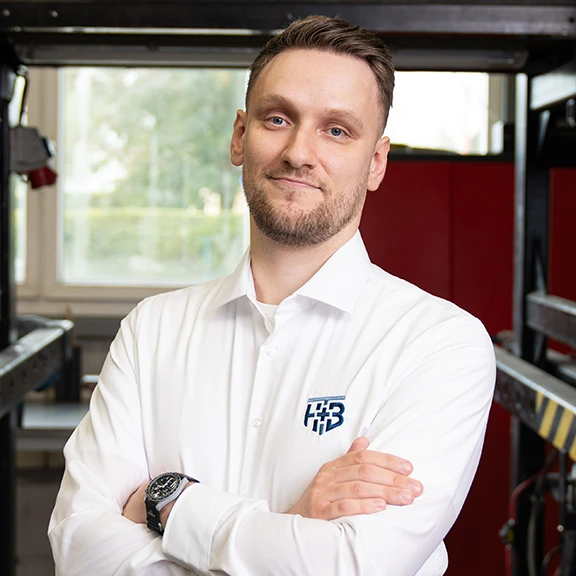
Tailored solutions perfectly suited to your needs. At H+B technics, we not only offer our proven products but also the opportunity to customize them according to your specific requirements. Our experienced team is ready to support you in developing and realizing bespoke products for your yacht or project, always with a strong focus on quality, innovation, and precision.
Whether it’s special dimensions, functions, or an entirely new design, we bring your vision to life. Rely on our expertise and let’s make your ideas a reality together.
Robin Zimmermann
Sales


Start your project
Tailored solutions perfectly suited to your needs. At H+B technics, we not only offer our proven products but also the opportunity to customize them according to your specific requirements. Our experienced team is ready to support you in developing and realizing bespoke products for your yacht or project, always with a strong focus on quality, innovation, and precision. Whether it’s special dimensions, functions, or an entirely new design, we bring your vision to life. Rely on our expertise and let’s make your ideas a reality together.


