

Lift System Rotation
Launching and retrieving a tender from the stern of a yacht is one of the most mechanically demanding operations in daily boat use. The tender needs to move from a secure stowage position on the swim platform down to the waterline — and back — without colliding with the transom, the drives, or any aft-mounted hardware. On vessels under 24 metres, where stern geometry is tight and the tender often weighs between 200 and 500 kg with fuel and equipment on board, a manual process is impractical. A davit crane works but swings the load through an arc that requires clear sky and calm conditions. What most owners and shipyards need is a lift system that moves the tender in a controlled, predictable path — straight down, clear of the hull, every time.
The Lift System Rotation does exactly that. It is a hydraulic tender lift built around a parallelogram lever arrangement that lowers the swim platform in a rotational arc while keeping the platform surface horizontally stabilised throughout the stroke. The geometry is designed so the platform moves outward and downward simultaneously — clearing the transom, drives, and stern attachments without risk of collision, even with wider tenders. In the stowed position, the platform sits flush at deck level with a hydraulic safety lock engaging automatically. In the lowered position, the tender floats free at the waterline, ready to launch or be retrieved.
The system is modular and divided into lift types based on load capacity: Type 1 (350 kg SWL), Type 2 (600 kg), Type 4 (800–1,000 kg), Type 5 (1,200 kg), Type 7 (1,600 kg), and Type 10 (2,000 kg). This range covers everything from a small RIB on a 35-foot sport cruiser to a 4.5- metre tender on a 24-metre motor yacht. Lift arms and main components are manufactured from stainless steel 1.4404 (AISI 316L) and 1.4462 (Duplex), electropolished for permanent saltwater use. Every system is delivered fully pre-assembled, pre-filled with hydraulic oil, and stecker-ready — reducing installation time at the shipyard to a minimum. Configuration and technical design are carried out in close collaboration with the customer by our engineering team in Münster.
Collision-free lowering path — horizontal stabilisation throughout the full stroke
The defining engineering principle of the Rotation Lift is its parallelogram lever arrangement. Two lift arms per side are connected through a linkage that constrains the platform’s motion to a specific rotational arc. As the arms rotate downward, the platform moves outward from the transom and toward the waterline simultaneously. At every point during this arc, the platform surface remains horizontally stabilised — the tender does not tilt, slide, or shift position during lowering or raising.
This geometry solves the most common problem with stern-mounted tender lifts: collision with the hull, drives, or trim tabs during the lowering stroke. Because the platform moves outward as it descends, it clears all aft-mounted hardware without requiring manual guidance or fender protection. For wider tenders — where the beam of the dinghy extends close to or beyond the edges of the platform — this collision-free path is not a convenience feature but a structural necessity. A conventional pivot lift that simply rotates downward on a single axis would swing the tender’s chine directly into the transom face.
The horizontal stabilisation also means the tender remains level during the entire operation. Fuel, gear, and loose equipment stay in place. There is no point during the stroke where the load shifts to one side or where the tender’s centre of gravity moves outside the platform’s support area. For the crew operating the lift, this translates to a predictable, hands-off process: press the button, the tender descends level, the tender floats free.
Mechanically secured in the stowed position — automatically operated by hydraulics
When the platform is in the raised, stowed position, a hydraulic safety lock engages automatically and secures the lift mechanically. This is not a hydraulic hold that depends on continuous pressure in the system — it is a physical locking mechanism that prevents any downward movement regardless of hydraulic pressure state. If the hydraulic system losespressure, if a hose fails, or if the power supply is interrupted, the platform stays locked at deck level. It does not drift, settle, or descend.
The lock disengages hydraulically when the operator initiates the lowering sequence. This means the entire locking and unlocking cycle is automatic — there is no manual pin, lever, or secondary action required from the crew. The system locks when it reaches the top, unlocks when you press the button to lower. This matters in daily operation because it eliminates the human error vector: forgetting to engage a manual lock before getting underway, or failing to disengage it before attempting to lower the platform.
For the shipyard and the classification engineer, a mechanical lock that is hydraulically operated and automatically engaged is the cleanest safety architecture for a stern-mounted platform carrying several hundred kilograms of tender at speed.
Six lift types covering the full range of tenders and vessel sizes
The Rotation Lift is not a single product — it is a modular system divided into six lift types based on Safe Working Load (SWL). Type 1 handles 350 kg, suited for small RIBs and jet skis on sport boats. Type 2 covers 600 kg, the most common range for 3-metre tenders on cruisers and flybridge yachts. Type 4 spans 800 to 1,000 kg for mid-size tenders. Type 5 lifts 1,200 kg. Type 7 reaches 1,600 kg. And Type 10 handles up to 2,000 kg — covering heavy tenders, large jet skis, or dual-use platforms on yachts up to 24 metres and beyond.
Within each type, the system offers numerous configuration options: platform carrier dimensions, arm length, mounting geometry, and control options are specified per project. The platform carrier itself is height-adjustable and inclinable, allowing precise alignment with the deck level to avoid gaps or height differences between the deck surface and the platform in the stowed position. This adjustability also accommodates different stern geometries — reverse transoms, plumb bows, stepped sterns — without requiring a dedicated product variant for each hull shape.
For the shipyard, this modularity means a single product family covers the entire tender handling range. For the owner, it means the lift is sized and configured exactly for their tender, their boat, and their usage pattern — not an oversized or undersized compromise from a fixed product catalogue.
Visual overview
Examine the Lift System Rotation from every angle — side profile showing the parallelogram lever arc, frontal view of the dual-arm configuration, and 45° perspective of the platform in stowed and lowered positions. Multiple lift types (2B, 5.35, 2.6) are shown in their respective vessel installations.
.webp)
.webp)
.webp)
.webp)
.webp)
Technical Specifications
Watch the Rotation Lift lower from the stowed position to the waterline. Follow the parallelogram lever geometry as the platform moves outward and downward in a controlled arc, keeping the tender level throughout the full stroke.
MATERIAL
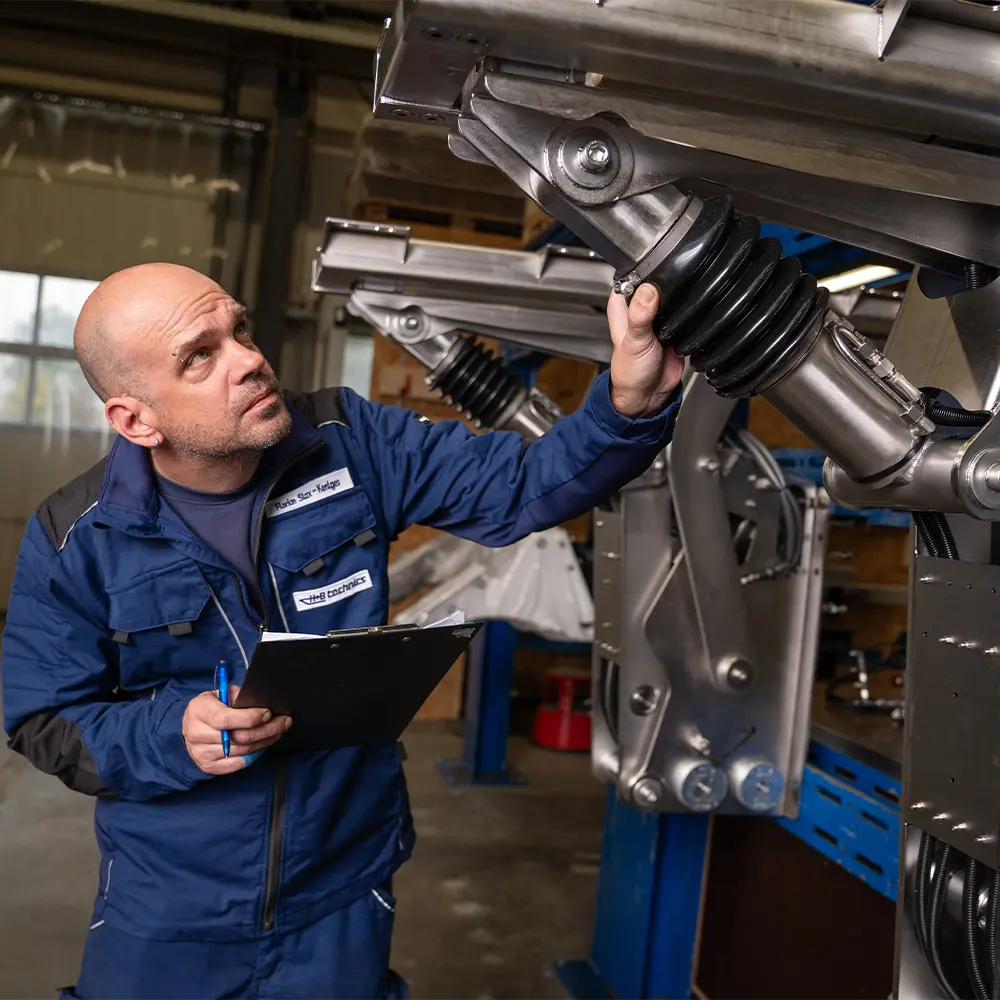
Lift arms and main structural components manufactured from stainless steel 1.4404 (AISI 316L) and 1.4462 (Duplex), electropolished for maximum corrosion resistance in permanent saltwater exposure.

HYDRAULICS
High-performance hydraulic unit calibrated for performance, pressure, and volume. Synchronised arm movement with equalizer control block (±2% tolerance). Delivered pre-filled with hydraulic oil, including hoses and fittings.
ANODES
Each lift system is equipped with zinc or aluminium anodes. Anode type selected based on vessel’s cathodic protection system and operating environment.

DELIVERY
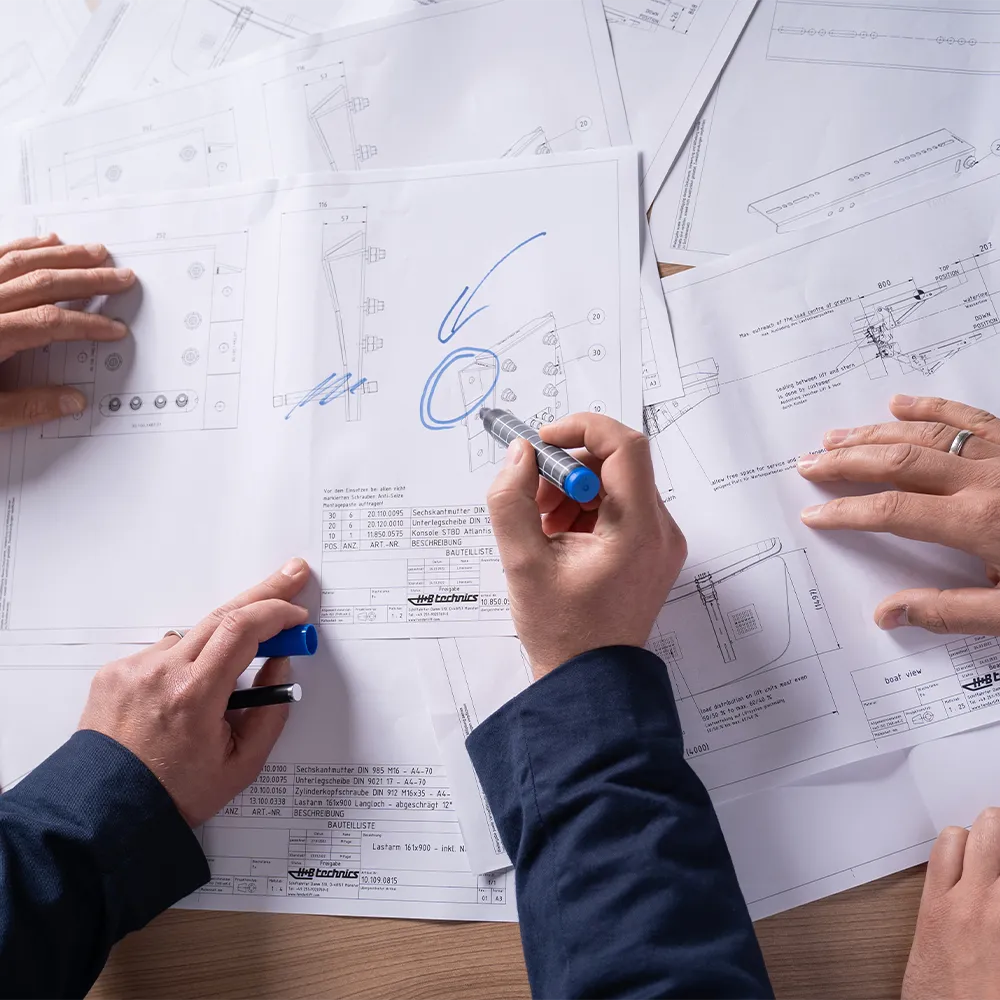
Fully pre-assembled and function-tested at H+B technics, Münster, Germany. Hydraulic unit pre-filled. Stecker-ready electrical connections. Detailed installation manual with photographs and technical drawings included.

"The lifts are not just functional — they match our design and standards. With H+B, it feels more like a team than a supplier relationship."

Frequently asked questions
Answers to the most common questions about the Lift System Rotation.
The lift type is determined by the tender’s weight (including fuel and equipment), the platform dimensions required, and the vessel’s stern geometry. Type 1 covers small RIBs and jet skis up to 350 kg. Type 2 handles the most common 3-metre tenders at 600 kg. Types 4 through 10 cover progressively heavier tenders up to 2,000 kg. Our engineering team advises on the correct type during the configuration phase.
The parallelogram lever arrangement constrains the platform to a rotational arc that moves it outward from the transom as it descends. This means the platform and tender clear all aft-mounted hardware — drives, trim tabs, exhaust outlets — without requiring manual guidance. The platform surface remains horizontally stabilised throughout the full stroke, so the tender stays level and does not shift.
The platform is secured by a mechanical safety lock that engages automatically when the lift reaches the stowed position. This lock holds the platform independently of hydraulic pressure. If pressure is lost due to a hose failure, power interruption, or any other cause, the platform remains locked at deck level. The lock can only be released hydraulically by an intentional lowering command.
Yes. The mounting interface is engineered for the specific vessel during the configuration phase. The system requires structural attachment points at the transom and a location for the hydraulic power unit. Electrical supply is standard 12V or 24V. The pre-assembled, stecker-ready delivery minimises installation time and complexity.
The standard equalizer control block synchronises arm movement with a tolerance of ±2%. The optional High Performance control block tightens this to ±1%, which is relevant for installations where extremely precise platform levelling is required — for example, with very wide platforms or heavy tenders where even small asymmetries would be noticeable.
Need more help?
Our team is ready to answer your questions
Customization option
Tailored solutions perfectly suited to your needs. At H+B technics, we not only offer our proven products but also the opportunity to customize them according to your specific requirements. Our experienced team is ready to support you in developing and realizing bespoke products for your yacht or project, always with a strong focus on quality, innovation, and precision.
Whether it’s special dimensions, functions, or an entirely new design, we bring your vision to life. Rely on our expertise and let’s make your ideas a reality together.
Jan Olfenbüttel
Head of Sales & Marketing


Start your project
Tailored solutions perfectly suited to your needs. At H+B technics, we not only offer our proven products but also the opportunity to customize them according to your specific requirements. Our experienced team is ready to support you in developing and realizing bespoke products for your yacht or project, always with a strong focus on quality, innovation, and precision. Whether it’s special dimensions, functions, or an entirely new design, we bring your vision to life. Rely on our expertise and let’s make your ideas a reality together.


